

I recently attended the International Conference on Ambulatory Monitoring of Physical Activity and Movement (ICAMPAM) in Knoxville, Tennessee. We heard some interesting perspectives on the use of wearables in clinical care from the leaders in the field (including some of the team at Enoda).
It is clear that advances in wearable technology mean that we can now robustly measure multiple constructs of interest such as movement and sleep. As Lang et al. (2026)1 point out, using wearables to capture this data is also considerably more scalable than alternatives such as clinical assessment. This combination of scalability and the capacity to capture objective data that accurately represents the underlying construct makes the use of wearables a compelling measurement tool. This can in turn facilitate more personalised care by providing data that can be used to better monitor disease progression, support rehabilitation, monitor treatment response and support patient self-management, to name but a few broad applications.
Despite this, we have not yet reached the point where objective data from wearable sensors are routinely used in clinical care. This has important implications, as work from Prof. Catherine Lang and others show that improvements demonstrated by patients during structured clinical tests (activity capacity) do not automatically translate to increased movement or functional use in their daily lives (activity performance). Indeed, this tension lies at the heart of the creation of the Mobilise-D project and the creation of Enoda. Clearly, the ability to function in daily life is what truly matters to patients, but unless we measure it directly, we may not be able to deliver optimal levels of care.
How Can We Bring Wearables into Clinical Care at Scale?
While the potential of wearables is clear, Lang et al. (2026) note that many second-generation research questions remain regarding how to quantify information, for whom, when, and with what variable(s). The reason for the lack of adoption is not that the sensors are incapable of collecting useful information. The challenge is converting the data into a verified, interpretable and actionable information.
As Prof. Lang pointed out at the ICAMPAM conference, we do have frameworks to guide us, so we should use them! For example, we have the Digital Medicine Society’s V3+ framework for validating digital health technologies and ensuring they are used optimally at scale. Prof. Lang also presented a number of considerations for moving validate data into the clinical care realm, as presented in the 2026 paper referenced above. The Mobilise-D project has provided an excellent paper from Mejia et al. (2025)2 offering guidance on the clinical utility of digital mobility outcomes for personalized clinical decision support in Parkinson’s Disease.
I have utilised these clinical frameworks and added some of my own thoughts regarding non-clinical elements (such as commercial and regulatory considerations) in the framework below. While not intended as a fully comprehensive and mature framework, it should provide a reasonable basis to address the question at hand by highlighting some of the difficulties faced when integrating wearables in clinical care settings.
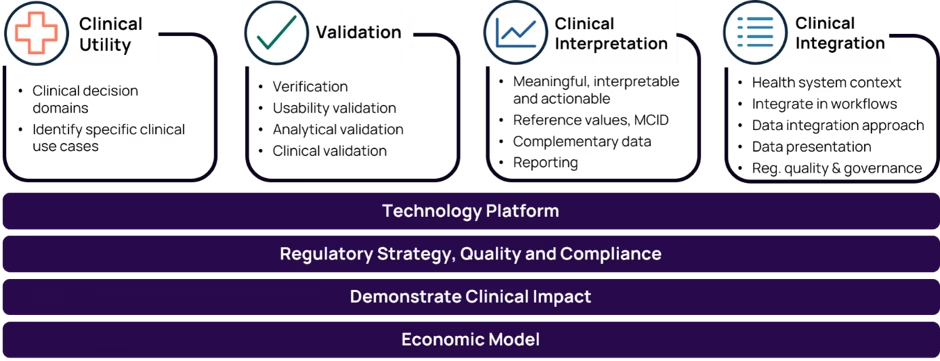
I will now address the individual elements above, outline some difficulties and present some thoughts on how they can be addressed.
Clinical Utility
Underlying every other element in this framework is the clinical decision domains the data will address, and the specific clinical use cases the data will support. Unless these are sufficiently compelling, any efforts to integrate digital biomarkers and other data generated from wearables into clinical care will fail, no matter how well executed. Patients must care about the aspect of health you are focussed on, and the data would ideally help empower them to better manage their condition. Clinicians must see the value in the data and believe it can help them improve care by addressing underserved needs when it comes to diagnosing, monitoring and treating patients. Involving both patients and clinicians as early as possible can build a solid foundation by ensuring this is the case.
Issues & Mitigations. A key potential issue here lies in the specificity of the use case(s). Focused use cases may be advantageous from a clinical point of view, but not from a commercial or funding perspective. Dr. Hans Bussmann noted this challenge during his talk at ICAMPAM, stating that applications sometimes had niche markets that limit commercial potential and cannot justify the costs of development and certification. These issues could be addressed by ensuring the concept you are measuring has multiple applications. For example, Mobilise-D has shown that the 24 Digital Mobility Outcomes developed in that project can provide clinically meaningful information across a range of conditions, unlocking numerous use cases and applications.
Validation
The Digital Medicine Society’s V3+ framework provides comprehensive guidance to ensure measures are fit for a specific clinical purpose. It covers four complementary areas:
- verification, confirming that the hardware and software accurately capture the intended sensor data;
- analytical validation, establishing that the algorithm reliably converts those data into an accurate physiological or behavioural measure against an appropriate reference standard;
- clinical validation, demonstrating that the measure meaningfully reflects the clinical concept of interest in the intended population and context; and
- usability validation, assessing whether intended users can use the technology safely, effectively, efficiently and satisfactorily in real-world settings.
Issues & Mitigations. A danger here lies in treating verification, analytical validation, clinical validation and usability as separate one-off exercises rather than interdependent activities. Another issue is clearly the potential cost of this validation. This could be mitigated by specifying the population, setting, users, measurement concept and decision purpose in advance. It is also advisable to involve patients and clinicians early and conduct formative usability testing before larger validation studies. This could help provide the evidence necessary to fund these larger studies.
Clinical Interpretation
Digital biomarkers and other data generated by wearables will not fulfil a useful clinical purpose unless they are meaningful, interpretable and actionable (Lang et al., 2026). Establishing reference data sets and developing estimates of minimal clinically important difference (MCID) can help clinicians and patients understand the data and take appropriate action. Key questions include:
- what constitutes normal or abnormal performance/function;
- what degree of change is meaningful;
- how values differ by disease stage, age, treatment state and comorbidity; and
- thresholds that should trigger review or intervention.
Data that is complementary to the wearable data should also be identified to help the decision-making process (patient reported data, clinical data, etc.). Good reports and visualisations are essential to help clinicians and patients understand the data and make efficient decisions in time constrained environments.
Issues & Mitigations. There can be a chicken and egg problem in generating reference data. To interpret a wearable measure, developers need reference data showing what values are normal, abnormal, clinically important, or predictive of an outcome. However, assembling large reference datasets requires funding, participant burden and clinical engagement, which are difficult to justify until the measure has shown its value.
Shared datasets and common data standards are one way of mitigating this. Precompetitive consortia, academic–industry partnerships and pooled control groups can spread the cost of collecting reference data (Mobilise-D and IDEA-FAST are two examples). It may also be wise to focus on a narrower range of core use cases with significant commercial potential initially. Over time, as more data is acquired, it may be more feasible to address less commercially promising use cases.
Clinical Integration
Measures must be integrated into clinical workflows, identifying who does what based on specific data. Data must be collected, stored, processed and possibly integrated with an Electronic Health Record (EHR). Data must also be presented effectively to clinicians (perhaps within an EHR). Finally, A key aspect to recognise is that, while work to promote clinical interpretation can be carried out independently of a health system context, work on clinical integration cannot. Processes, systems and governance vary from system to system, and so will integration.
Issues and mitigation. Heterogenous systems mean that integration presents challenges when it comes to scalability and commercial considerations. Lang et al. (2026) discuss the use of an “intermediate platform for storage and processing prior to integration” (p.10) as a solution to address storage issues of EHR systems, but it could also help address scalability issues of dealing with multiple EHRs. If integration can be focussed on a limited number of outputs, this should help reduce costs.
A second mitigation is to focus initially on markets with the largest commercial potential that can bear these integration costs. As systems are developed and matured, the marginal costs of integrating may decline, opening up smaller markets.
Technological Platform
Underpinning the work above is a technological platform capable of efficiently capturing, ingesting, processing, storing and presenting the data. A key objective is to make this process as seamless as possible for patients and clinicians. Consideration should be given to the minimising the burden placed on patients in gathering the data, while considering any ethical implications. Robust processes should be in place to maintain data integrity and provenance, while governance and security considerations are also paramount.
Issues and mitigation. Multiple issues may arise, particularly if requirements are not adequately defined. Work on adherence and usability in the validation stage above should play a key role in guiding the development of the platform and mitigating these issues.
Regulatory Strategy, Quality and Compliance
If the data is to be used within clinical care pathways, then the system for obtaining that data must be qualified as a medical device (or software as a medical device). Device classification and pathway depend on intended purpose, software function, risk and the architecture of the complete system. However, even if there is no immediate physical risk to the patient as a result of using the wearable/device, it will may require a Class II designation (or IIa in Europe) if the data is to be used to make clinical decisions. Most Class II devices require 510(k) clearance in the US, and that the usual test is substantial equivalence to an existing predicate device. Where no suitable predicate exists, a novel low-to-moderate-risk device may use the De Novo pathway.
A predicate-equivalence argument is not the central route in the EU. Here conformity with the EU’s Medical Device Regulation (MDR) must be demonstrated. An ISO 13485-based quality-management system is normally used and audited by designated ‘Notified Bodies’ alongside specific MDR obligations.
Issues and mitigation. Costs may be significant depending on the degree of clinical evidence required to obtain regulatory qualification. This will be driven by the intended use and marketing claims, so careful consideration must be given to both. The intended use and marketing claims should be sufficient to market the product for its intended use, but not so broad that they bring unnecessary cost.
Demonstrate Clinical Impact
If the use cases for wearable-based measures are to be successful, their benefits relative to alternatives must be apparent to patients and clinicians. Ideally a formal study would show that using the measure improves standards of care compared with the current practice. For example, the data would facilitate earlier intervention from clinicians, improve treatment selection, identify deterioration more effectively, reduce unnecessary visits or improve patient outcomes. Correlation with a clinical scale alone is not sufficient.
Issues and mitigation. While a well-designed study contrasting outcomes achieved by the wearable data with existing methods is undoubtedly the gold-standard, these may be costly, resource intensive and time-consuming. Other forms of evidence could also play a role. For example, quantitative and qualitative feedback could be obtained from patients and clinicians regarding the use of the wearable, platform, data, etc. Transactional metrics, such as the number of patient visits to a clinic, could also be compared. Provided this evidence is obtained in a robust manner, it could serve as useful (if incomplete) evidence of clinical utility.
Economic Model
Whatever the clinical merits of the use cases identified, they must be shown to merit the funding required to develop and implement them. If the source of the funding is commercially orientated (e.g. venture capital), then a compelling business case must be developed. Clinical value will need to be combined with economic value (reduced costs and/or increased revenues), and who ultimately pays for the service will need to be identified. Health systems where reimbursement is a key feature adds further complexity.
Health technology assessments may be employed where pricing decisions are made by public health systems or insurance programs, as well as for large-scale funding programs. This will introduce broader concepts of economic value, as the goal is to maximise overall population health value for money spent, as opposed to value on invested capital.
Issues and mitigation. A well-developed economic model is essential for success. Its potential will ultimately be tied to the use cases, and so consideration of the economic model should occur alongside the development of the use cases. If the costs of a use case cannot be justified by its economic and societal benefits, then it is unlikely to be implemented.
Maximising Chances of Success
Clearly there is a lot of work and resources required to bring wearables into routine clinical care. This, in itself, is not an insurmountable challenge if the rewards justify it. One of the key issues apparent across a number of the aspects discussed above is fragmentation, and I believe this is a key factor that has limited the use of wearables to date. Human health is highly complex, and even a single condition such as Parkinson’s can have a wide heterogeneity of clinical presentations. This actually reinforces the need for wearables that can gather accurate data that can be used to tailor interventions to a patient’s specific characteristics (‘personalised care’). However, it also means that use cases and digital biomarkers can be fragmented and limited to specific populations, decreasing revenue potential and increasing costs.
Ensuring that the potential rewards outweigh the costs requires taking an entrepreneurial mindset form the outset. Focus on areas where significant pain points and information gaps exist without solutions that are both effective and scalable. Identify areas where clinicians face significant difficulties in diagnosing, treating and monitoring patients, and patients lack data that can help them manage their condition. Involve patients and clinicians as much and as early as possible so assumptions can be validated and solutions iterated.
Wearables are capable of capturing large volumes of data efficiently, and developments in artificial intelligence open up many opportunities to leverage this data in new and impactful ways. A number of questions can help assess the potential of a given use case.
- Can the data be used to address significant and underserved needs when it comes to diagnosing, treating and monitoring patients?
- Is the data interpretable and actionable to patients and clinicians?
- Does the data address an aspect of health that patients care deeply about? Can it empower them to better manage their condition?
- Do the benefits of using the data outweigh the burden of collecting it?
- Do the economic and societal benefits presented by the use cases justify the costs of developing and delivering the solution?
If these questions can be addressed satisfactorily, then will be opportunities to improve standards of care and outcomes for patients. Despite the many challenges, the potential rewards remain significant. Wearables will not enter routine care simply because they can collect data accurately and efficiently. They will succeed when validated measures can be interpreted for an individual patient, linked to a defined clinical action and be shown to improve care at a sustainable cost. The potential is clear, and with the systematic application of existing frameworks, it can be realised.
- Lang CE, Miller AE, Macpherson CE, Bland MD, Holleran CL, Lohse KR. Advancing Neurorehabilitation and Recovery Through Human Movement Quantification via Wearable Sensing. Neurorehabil Neural Repair. Published online 2026. doi:10.1177/15459683251412310
- Mejia AC, Sapienza S, Paccoud I, et al. Consensus on the clinical utility of digital mobility outcomes for personalized clinical decision support in parkinson’s disease. Neurol Res Pract. 2025;7(1). doi:10.1186/s42466-025-00426-8